
This is an old revision of the document!
Ordinary differential equation models
Coupled ODE lattice: Lateral signaling
Introduction
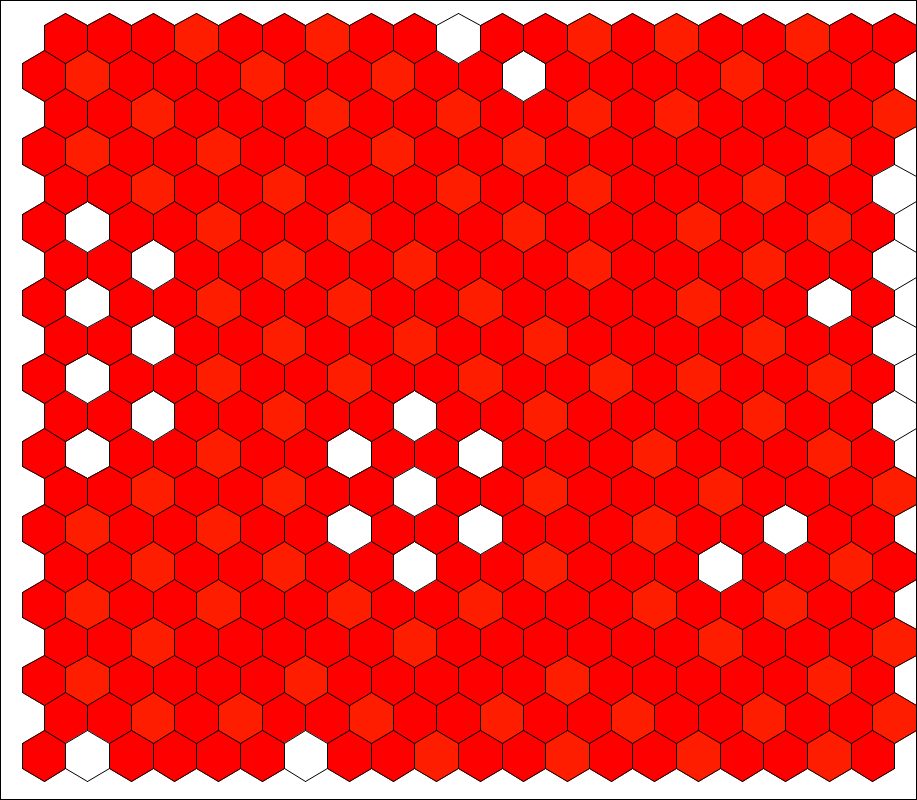
This example model cell fate decisions during early patterning of the pancreas (de Back et al., 2012). The simple gene regulatory network of each cell is coupled to adjacent cells by lateral (juxtacrine) signaling.
Model description
The model defines a lattice of cells with a simplified hexagonal epithelial packing. This is specified in Space using a hexagonal lattice structure of size $(x,y,z)=(20,20,0)$ with periodic boundary conditions. The lattice is filled by seeding it with a Population of $400$ cells.
Each cell has two basic Properties X and Y representing the expression levels of Ngn3 and Ptf1a that are coupled in a System of DiffEqns.
The NeighborsReporter plugin is used to couple the cells to their directly adjacent neighbors. This plugin checks the values of X in neighboring cells and outputs its mean value in Property Xn.
This model uses a number of Analysis plugins:
Gnuplottervisualizes the values of Y with aColorMapthat maps values to colors. It outputs to screen (interactive mode) or to PNG (local mode).Loggerrecords the values of X and Y expression to file and, at the end of simulation, shows a time plot.- The first
HistogramLoggerrecords and plots the distribution of X and Y expression cells over time. - The second
HistogramLoggerrecords and, after simulation, plots the distribution of $\tau$, the time to cell fate decision (see reference).
Model
h LateralSignaling.xml |h
extern>http://imc.zih.tu-dresden.de/morpheus/examples/ODE/LateralSignaling.xml
In Morpheus-GUI:
Examples → ODE → LateralSignaling.xml.
Things to try
- Change the lattice structure from hexagonal to square. See
Space/Lattice. - Change the strength of lateral stabilization
band observe the pattern. SeeCellTypes/CellType/System. - Change the noise amplitude and observe time to cell fate decision ($\tau$).
Reference
W de Back, J X Zhou, L Brusch, On the Role of Lateral Stabilization during Early Patterning in the Pancreas, Journal of the Royal Society Interface, 10:79, 2013.